AC repair in Estero and southern Lee County
When the house won’t cool down, we find the reason, show it to you and fix it. We repair central air, heat pumps, air handlers and ductless mini-splits in Estero, Bonita Springs and south Fort Myers.
Signs your AC needs a repair
Call us if you notice any of these.
- Warm or room temperature air coming from the vents
- The outdoor unit hums, but the fan on top doesn’t spin
- Water on the floor around the air handler, or a pan that’s full
- The system shut itself off and won’t come back on
- Ice on the copper line at the outdoor unit or on the indoor coil
- A breaker that trips when the AC kicks on
- Short cycling, where the system runs a few minutes, stops and starts again
- A thermostat calling for cooling while nothing happens
What usually fails, and how we check it
Most of our AC repair calls come down to a short list of parts.
Capacitor
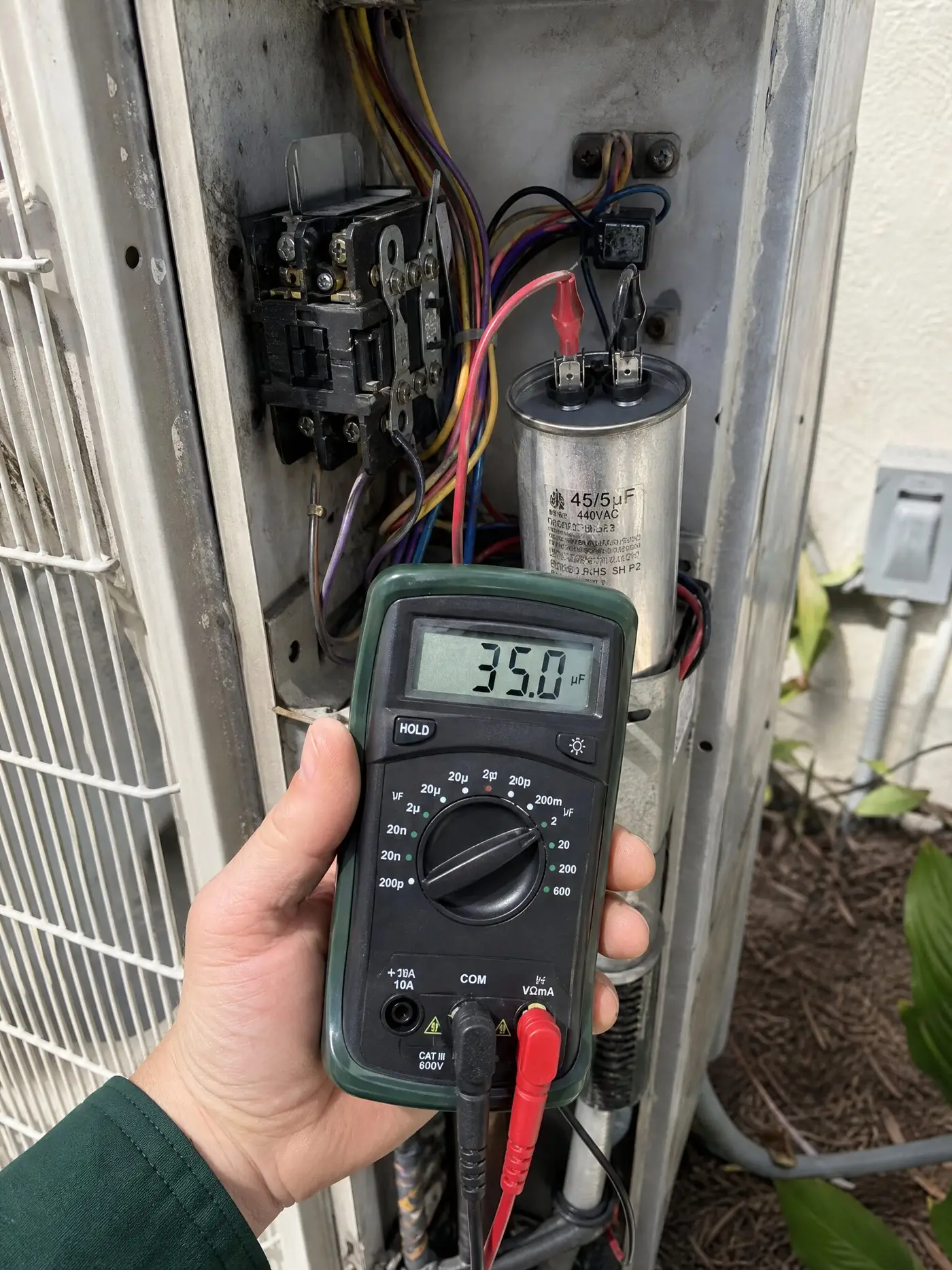
It gives the compressor and the outdoor fan the push they need to start, and heat wears it down. We put a meter on it and compare the reading to the rating printed on the side. More in our capacitor guide.
Contactor
This is the switch that sends power to the outdoor unit when the thermostat calls. Its contacts pit and burn over time, and UF/IFAS notes that fire ants nest inside electrical housings and can short them out.
Drain line and float switch
A clogged condensate line backs water into the pan until the float switch shuts the system off. See our drain line guide.
Refrigerant leak
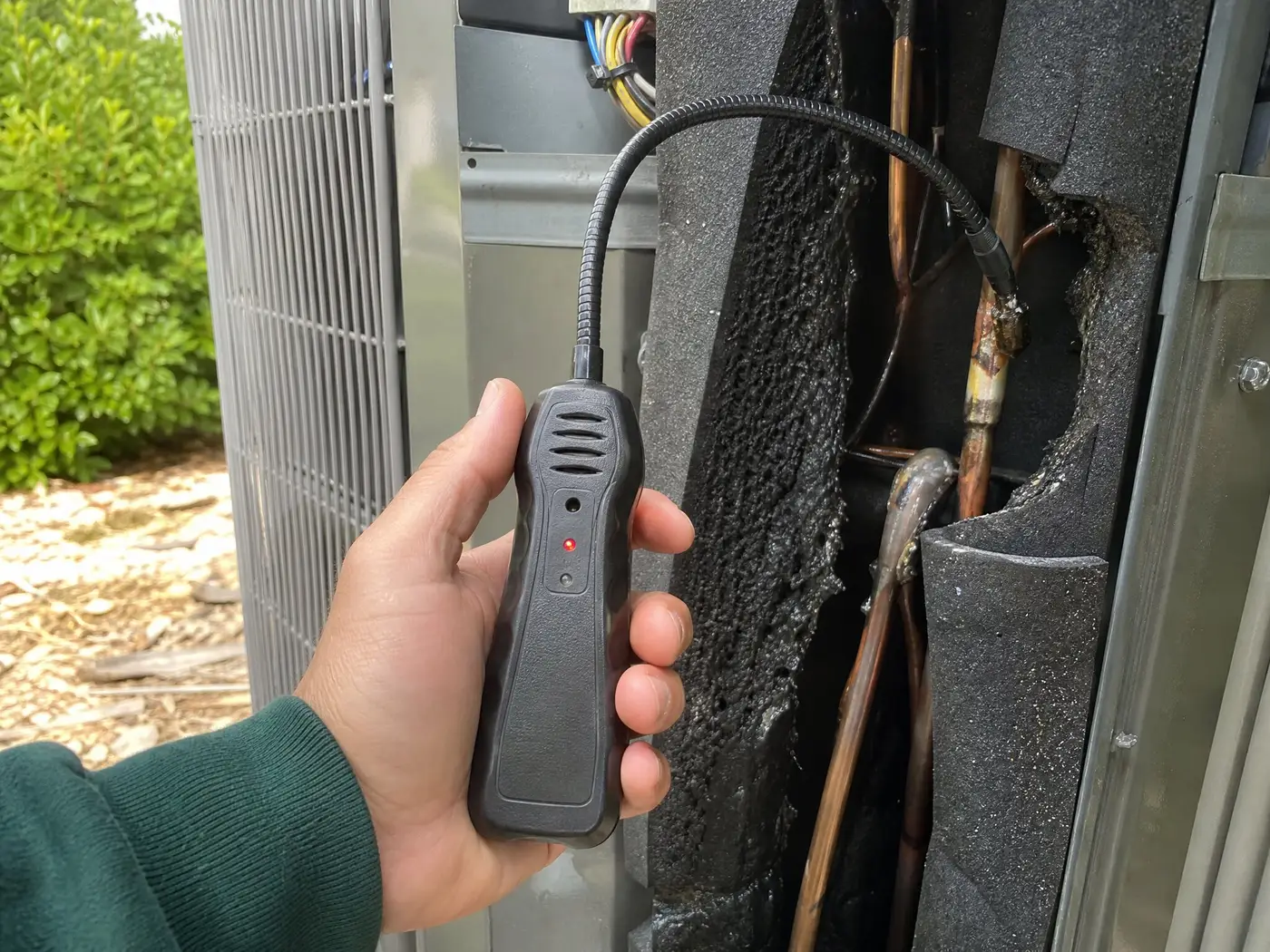
Low charge means a leak. We find it with an electronic detector and bubble solution, then tell you whether it’s a valve, a fitting or a coil.
Fan and blower motors
Both run long hours here. A motor that’s slow to start, loud or hot to the touch is on its way out, and we can usually tell before it quits.
Control board and thermostat
After a storm, a dead system can be a blown fuse or a damaged board in the air handler. We check the low voltage side before anything gets replaced.
Low on refrigerant means a leak
Refrigerant runs in a closed loop. It doesn’t burn off like gas in a car, so if the charge is low, it went somewhere.
The EPA asks homeowners to have leaks found and repaired instead of having the system topped off, and venting refrigerant on purpose is illegal. We agree with the first part on cost alone. Topping off a leaking system means paying for the same refrigerant again next summer.
Once we know where the leak is, we can tell you whether it’s a quick repair, like a leaking valve core or a line rubbing on the cabinet, or a coil that’s finished. If your nameplate says R-22, that matters too: no new R-22 has been made or imported in the US since January 1, 2020, so repairs on those systems rely on reclaimed supply.
How an AC repair visit works
You tell us what it’s doing
Warm air, water on the floor, a hum outside, a breaker that trips. The more detail you give us, the better we can plan.
We test before we guess
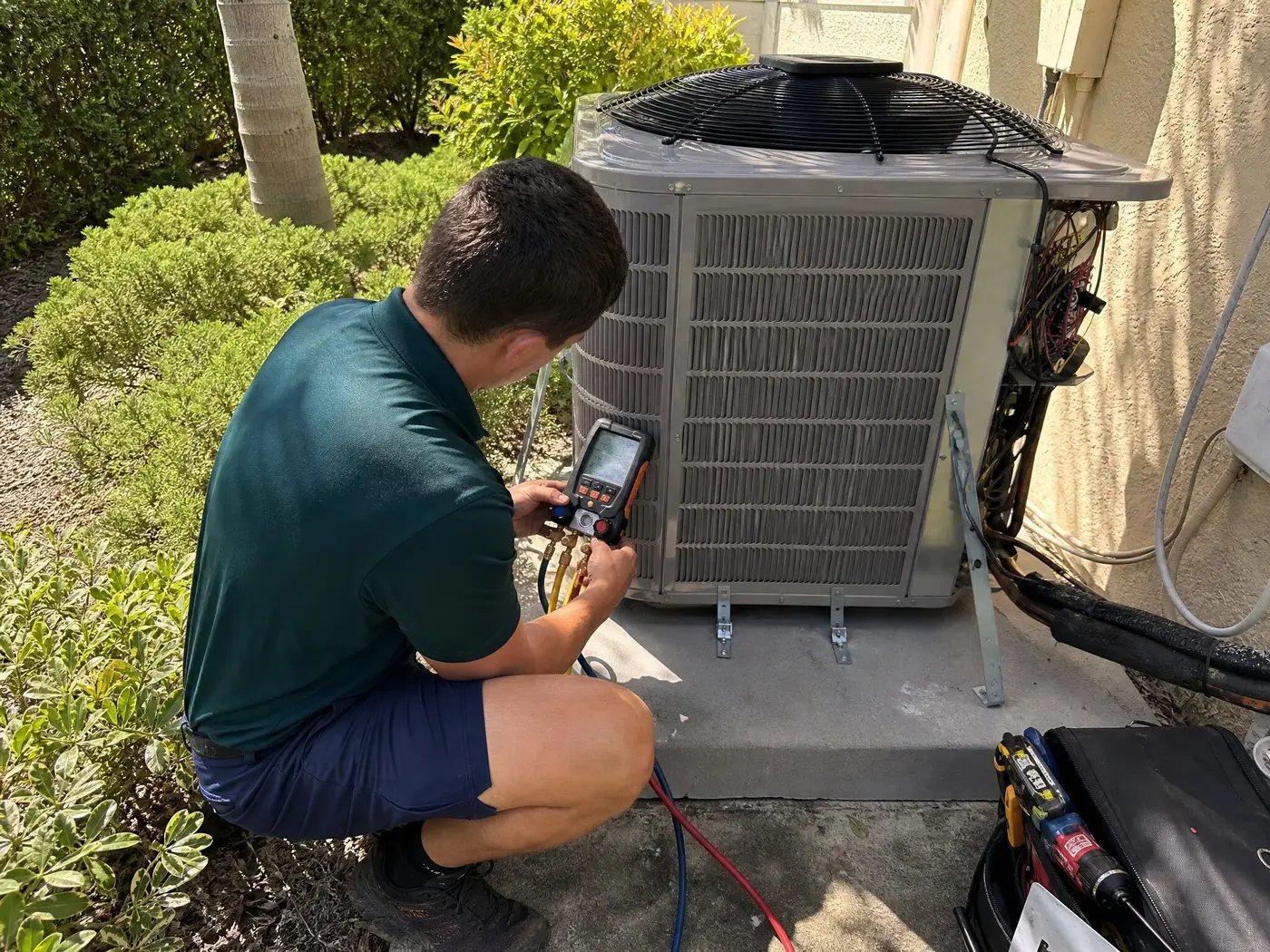
Refrigerant pressures, the capacitor and contactor, the drain, the float switch, the thermostat wiring. We look at the whole system, not one part.
You see what failed
We show you the part or the reading and explain it in plain words. Then you get the price.
We fix it and check the air
After the repair we watch the system run and measure the air coming out of a supply vent before we pack up.
Storms, surges and frozen coils
If the outdoor unit goes silent after a storm, check the breaker once. If it trips again, leave it off and call us, because something in the system is pulling more current than it should.
Ice is a different problem. Manufacturers point to restricted airflow (a dirty filter, a blocked return, a dirty coil) and low refrigerant as the usual causes. Turn the system off at the thermostat, change the filter, and let the ice melt on its own. Don’t chip at it, because that can damage the coil.
Water coming through a ceiling under an attic air handler? Turn the system off at the thermostat first. That stops new water from forming while you call us.
AC acting up? Tell us what it’s doing.
Call or text, or tap the chat button in the corner. Tell us what the system is doing and where you are, and we’ll take it from there.
Related
AC installation
New central AC, heat pump and mini-split systems sized with a load calculation, set level, anchored and finished with a drain built to stay clear.
AC installation detailsAC maintenance
Tune-ups that rinse the coils, flush the drain, test the capacitor and check refrigerant pressures before the rainy season puts the system to work.
AC maintenance detailsFailing AC capacitor
Humming outdoor unit, fan not spinning, AC slow to start? How a failing capacitor shows itself and why Florida heat wears it out.
Read the guideQuestions we get
How much does an AC repair cost?
It depends on what failed. A capacitor and a compressor are very different jobs. We diagnose first and give you the price before we start, so you’re never guessing.
Should I keep running the AC if it’s blowing warm air?
No. Turn it off at the thermostat. Running a system that’s low on refrigerant or struggling to start puts wear on the compressor, which is the most expensive part to replace.
Why is there ice on my AC line?
Usually it’s airflow or refrigerant. A clogged filter or a dirty coil starves the coil of warm air, and a leak drops the pressure until the coil freezes. Turn it off, change the filter and call if it freezes again.
Do you repair ductless mini-splits?
Yes. We repair mini-splits along with central systems and heat pumps, including drain problems at the indoor head, which are common.
Do you fix heat pumps in heating mode too?
Yes. A heat pump uses the same refrigerant circuit for heating and cooling, so we work on both sides of it.