Signs of a failing AC capacitor, and why Florida heat wears them out
The capacitor is a small metal can in your outdoor unit that gives the compressor and the fan motor the push they need to start and keep running. It’s one of the parts we replace most in Estero, and it usually gives you warning first.
What the capacitor does
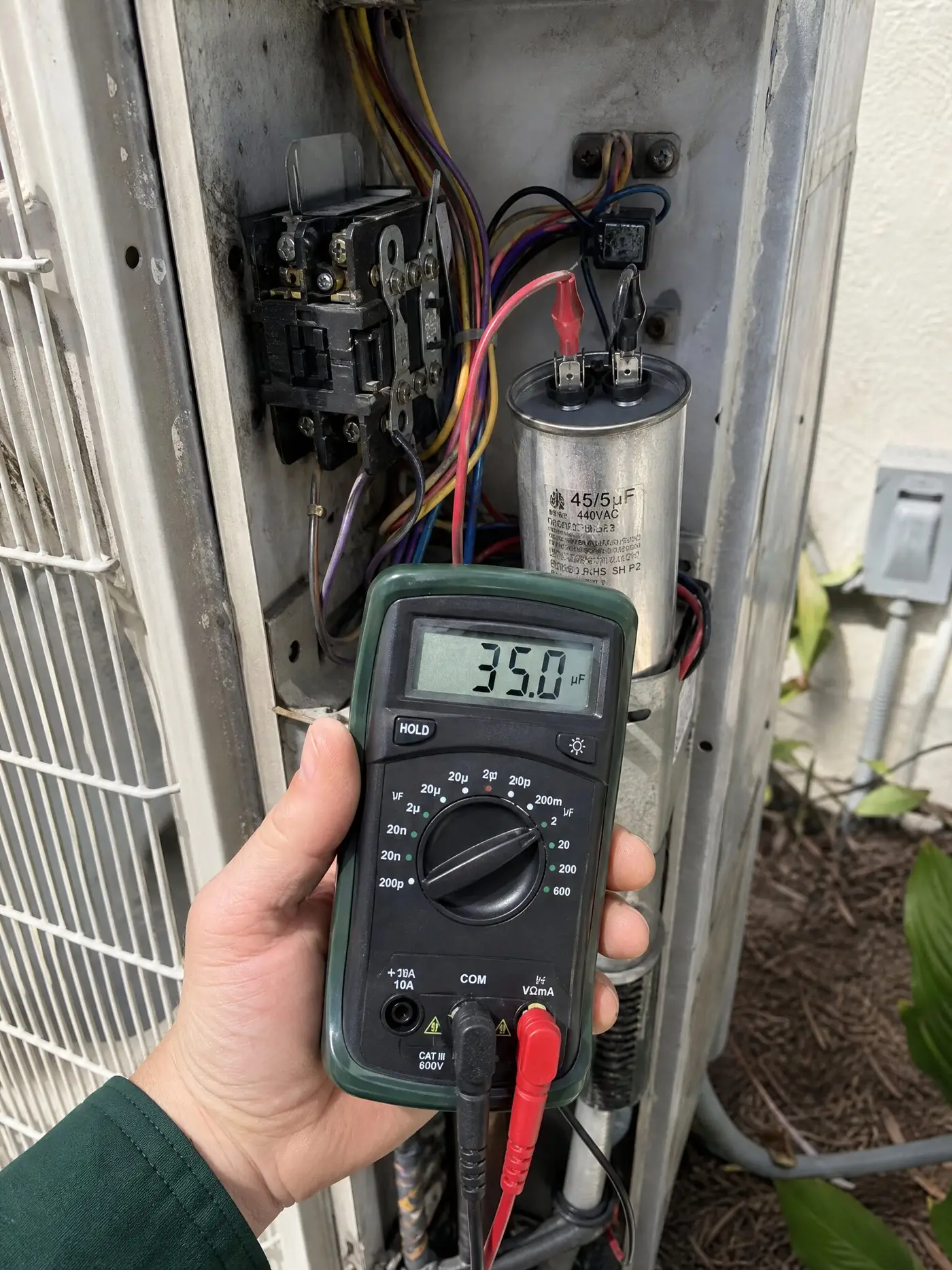
Most outdoor units use a dual run capacitor. It’s two capacitors in one can, with three terminals marked C for common, HERM for the compressor and FAN for the condenser fan motor.
The label gives two ratings in microfarads. On the one in the photo, 45/5 means 45 for the compressor and 5 for the fan. When either side drops too far below its number, the motor it serves struggles to start or won’t start at all.
A capacitor is cheap next to the motors it serves, which is why we test it on every repair call and every tune-up. Catching a weak one in April costs a lot less aggravation than losing it in July.
Signs of a bad AC capacitor
- The outdoor unit hums or buzzes but the fan on top doesn’t turn
- The fan clicks off for a second and then restarts
- The AC won’t turn on at all, or takes a few tries to start
- Little airflow or no cooling inside the house
- Lights dim when the AC starts, or the breaker trips
- The top of the capacitor is bulged, leaking or scorched
Why capacitors fail in Florida heat
Heat is the main thing. One capacitor maker’s data sheet rates its standard parts for 60,000 hours at full voltage and rated temperature, and its own charts show that life getting shorter as the temperature and the voltage go up.
Now picture where yours lives. The outdoor unit sits on a concrete pad in full Estero sun, and the capacitor is inside the cabinet next to a compressor that runs most of the day for months on end. There isn’t much of a break from spring into fall.
Storms pile on. The National Weather Service warns that lightning surges can damage electronics some distance from the strike, and a capacitor that was already weak often fails the week of a big storm.
How we test an AC capacitor
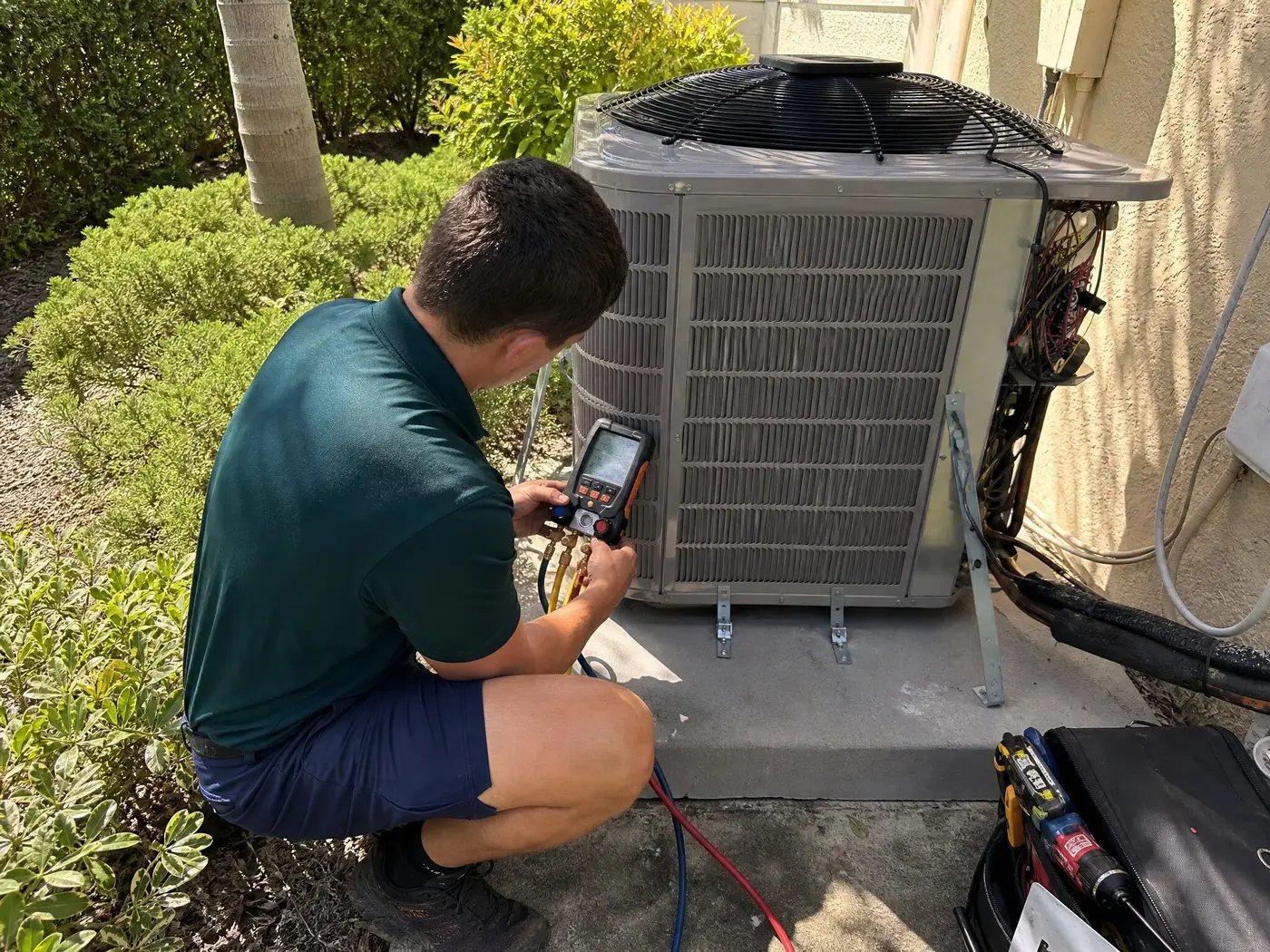
First the power goes off at the disconnect. Then we discharge the capacitor, pull the wires and put a meter on each side, set to microfarads.
We compare the readings to the label. Standard parts carry a tolerance of plus or minus 10 percent, with tighter 6 and 3 percent versions available. The capacitor in the photo is rated 45 on the compressor side and reads 35, which is more than 20 percent low. That one’s done.
If the can is bulged, leaking or burnt, we don’t need the meter to know. It gets replaced with one that matches the ratings on the old label, and we show you the old one and the reading.
What to do if you think it’s the capacitor
Turn it off
Set the thermostat to Off. A compressor that keeps trying to start on a weak capacitor is working hard for nothing.
Look and listen from a distance
With the cover on, check whether the outdoor fan spins and whether the unit hums. Don’t open the panel or poke at the fan.
Check the breaker once
If it tripped, reset it one time. If it trips again, leave it off.
Call us
Tell us what you heard and saw. That usually lets us bring the right part on the first trip.
Don’t test or swap a capacitor yourself unless you know how to discharge it. It can hold a charge with the power off, and that charge can give you a dangerous shock.
While we’re in there
A capacitor swap is a short job, so we use the visit to check the parts around it. The contactor next to it gets a look for pitting and ant nests, the fan motor gets checked for drag, and we watch the compressor start to make sure the new part fixed it.
If the capacitor tested fine and the unit still won’t start, the problem is somewhere else, and we’ll tell you that rather than sell you a part you don’t need. Our AC repair page covers the other usual suspects.
AC acting up? Tell us what it’s doing.
Call or text, or tap the chat button in the corner. Tell us what the system is doing and where you are, and we’ll take it from there.
Need ac repair?
AC repair is what we do every day. Call or text and tell us what the system is doing.
Questions we get
Can a bad capacitor make the AC blow warm air?
Yes. If the compressor can’t start, the indoor blower can keep running and push air through the house that never gets cooled.
How long does an AC capacitor last?
There’s no fixed number. Makers rate life at a set temperature and voltage, and more heat or higher voltage shortens it. In our climate, we test them at every tune-up instead of guessing.
Should I replace a capacitor before it fails?
If it tests well below its rating at a tune-up, yes. A weak capacitor won’t recover, and it’s an easy part to change on a mild day.
Why did my capacitor fail right after a storm?
Lightning surges can damage electronics some distance from the strike, according to the National Weather Service. A capacitor that was already worn down by heat is often the first part to go.
Is a humming outdoor unit always the capacitor?
No. It’s a common cause, but a stuck fan motor or a compressor problem can hum too. The meter tells us which one it is.